Tricho-Vision
Computer vision for trichotaxonomy and wildlife conservation
Tricho-Vision applies computer vision to trichotaxonomy — the classification of mammalian hair microstructures — to enhance wildlife conservation of priority species. Published in Ecological Informatics (2025).
Motivation
Manual identification of species via hair (cuticle and medulla) analysis is time-consuming and requires expert knowledge. Automated vision pipelines can scale species identification from microscopy images, aiding biodiversity monitoring and wildlife-crime forensics.
Contributions
- Curated the first benchmark dataset of 76 conservation-priority species, including critically endangered taxa
- Classifies hair across four taxonomic levels — Order, Family, Genus, Species
- Benchmarks CNNs, ViTs, and Swin Transformers; Swin Transformers perform best across all levels
- Image cropping further improves accuracy by diversifying the training set
Dataset
| Property | Value |
|---|---|
| Species in dataset | 76 (incl. endangered) |
| Taxonomic levels | 4 (Order / Family / Genus / Species) |
| Architecture families | 3 (CNN / ViT / Swin) |
| Best architecture | Swin Transformer |
| Hair features analyzed | Cuticle patterns + medulla |
Results
Accuracy (%) across taxonomic levels — Swin Transformers lead, with Swin-V2-Base best at the fine-grained Species and Genus levels:
| Method | Species | Genus | Family | Order | Inf. (ms) |
|---|---|---|---|---|---|
| ViT-Base | 70.60 | 74.90 | 87.48 | 95.84 | 4.02 |
| EfficientNet-b3 | 69.49 | 73.71 | 86.73 | 95.11 | 12.17 |
| DeiT-Base | 70.03 | 74.96 | 87.45 | 95.24 | 12.29 |
| BEiT-Base | 70.07 | 74.92 | 87.72 | 95.98 | 15.70 |
| Swin-Base | 71.60 | 75.07 | 88.41 | 95.98 | 3.56 |
| Swin-V2-Base | 72.63 | 76.27 | 88.25 | 95.90 | 14.64 |
| ResNet-50 | 66.90 | 72.88 | 86.35 | 94.99 | 15.96 |
| MobileNetV2 | 40.38 | 68.66 | 80.90 | 92.92 | 17.51 |
Accuracy drops steadily from coarse (Order) to fine-grained (Species) labels, and the best Swin model stays consistently ahead of the CNN baseline at every level:
{
  "tooltip": { "trigger": "axis" },
  "legend": { "data": ["Swin-V2-Base (best)", "ResNet-50 (CNN baseline)"], "top": "2%" },
  "grid": { "left": "3%", "right": "4%", "bottom": "3%", "containLabel": true },
  "xAxis": { "type": "category", "data": ["Order", "Family", "Genus", "Species"] },
  "yAxis": { "type": "value", "name": "accuracy (%)", "min": 60, "max": 100 },
  "series": [
    {
      "name": "Swin-V2-Base (best)",
      "type": "bar",
      "data": [95.9, 88.25, 76.27, 72.63],
      "itemStyle": { "color": "#4f8ef7", "borderRadius": [4, 4, 0, 0] }
    },
    {
      "name": "ResNet-50 (CNN baseline)",
      "type": "bar",
      "data": [94.99, 86.35, 72.88, 66.9],
      "itemStyle": { "color": "#b9c4d0", "borderRadius": [4, 4, 0, 0] }
    }
  ]
}
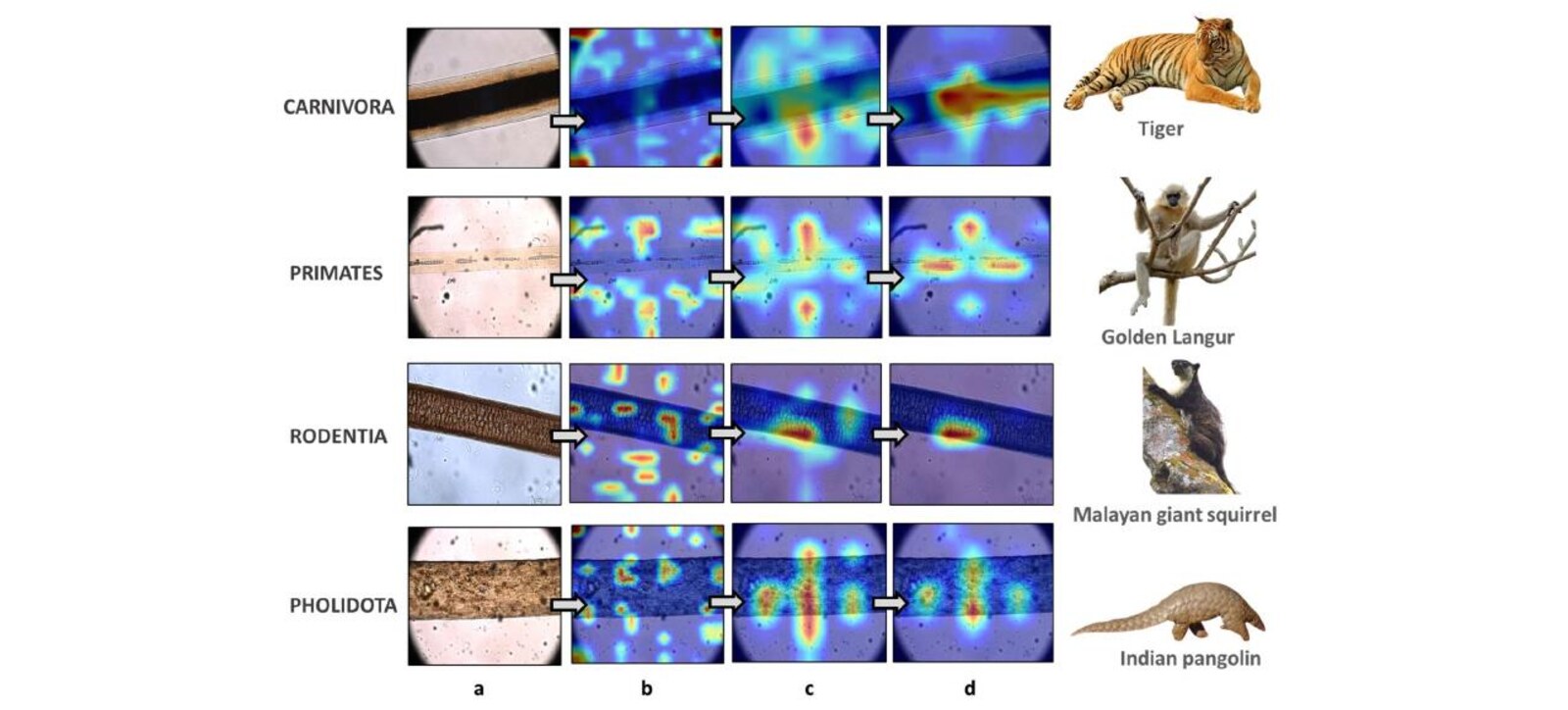
Activation Maps
Publication
Das, A., Banerjee, P., Biswas, S. et al. Tricho-Vision: The use of computer vision in trichotaxonomy for enhancing wildlife conservation of priority species. Ecological Informatics, 2025.
Work done at Habitat Lens Private Limited.